Wednesday, July 9, 2014
Sunday, March 2, 2014
THE JUST ONE BAD CENTURY RELAUNCH
In case you missed it, we have relaunched our website Just One Bad Century. After six years of serving Cubs nation with our old design, we figured it was time to spruce up the joint a bit. It remains the #1 spot to find stories about the interesting and complicated history of the Chicago Cubs.
What will you find on Just One Bad Century?

UPDATED DAILY
*Today's Cubs birthdays. Brief bios and stories about every Cub (and Cub-related personality) celebrating a birthday on that particluar day. By the end of this year, JOBC will have every single player who ever wore the Cubs (or White Stockings, Colts, or Orphans) uniform in the archives.
*The A/V Club. A video or audio clip about the Cubs. Check the homepage for new videos or audio clips every single day.
These items used to be here on the JOBC Blog, but will now migrate back to our mother site.
UPDATED WEEKLY
*This Week in Wrigley History. Once the season begins you'll see stories about the best games played that week in Wrigley history. There's a hundred years of stories to choose from, and we think we've chosen the best.
*Historical Events: Where were the Cubs? Have you ever wondered what the Cubs were up to during Custer's Last Stand? President Garfield, McKinley, and Kennedy's assassinations? When man walked on the moon? Our research staff has gone through the archives and will deliver those stories to you weekly. If it happened in history between the end of March and the beginning of November any year since 1871, we've got a corresponding Cubs story to share.
*This Week in 1908. Our award-winning chronicle returns with photos, videos (silent ones), and profiles of what was happening the last year the Cubs won the World Series.
*This Week in 1945. This popular segment also finds a spot in our new home, with updated stories, photos, and newsreel videos from the last year the Cubs were in the World Series.
JOBC CONTEST
 *We have a chance for you to win $1908 in cold hard cash. All you have to do is pick the exact date and starting pitcher of the Cubs on the day they clinch their next World Series championship. Piece of cake, right? (I'm picking my son on November 1, 2030, but I don't want to sway your vote)
JOBC PRODUCTS
*We're particularly proud of our new "Building Character Since 1909" t-shirt, but the old favorites are still available in the JOBC Store.
And there's much much more at www.justonebadcentury.com, including all the latest news about the Cubs, and some of my own personal Wrigley Field memories. Be sure to stop by and join in the fun.

What will you find on Just One Bad Century?

UPDATED DAILY
*Today's Cubs birthdays. Brief bios and stories about every Cub (and Cub-related personality) celebrating a birthday on that particluar day. By the end of this year, JOBC will have every single player who ever wore the Cubs (or White Stockings, Colts, or Orphans) uniform in the archives.
*The A/V Club. A video or audio clip about the Cubs. Check the homepage for new videos or audio clips every single day.
These items used to be here on the JOBC Blog, but will now migrate back to our mother site.
UPDATED WEEKLY
*This Week in Wrigley History. Once the season begins you'll see stories about the best games played that week in Wrigley history. There's a hundred years of stories to choose from, and we think we've chosen the best.
*Historical Events: Where were the Cubs? Have you ever wondered what the Cubs were up to during Custer's Last Stand? President Garfield, McKinley, and Kennedy's assassinations? When man walked on the moon? Our research staff has gone through the archives and will deliver those stories to you weekly. If it happened in history between the end of March and the beginning of November any year since 1871, we've got a corresponding Cubs story to share.
*This Week in 1908. Our award-winning chronicle returns with photos, videos (silent ones), and profiles of what was happening the last year the Cubs won the World Series.
*This Week in 1945. This popular segment also finds a spot in our new home, with updated stories, photos, and newsreel videos from the last year the Cubs were in the World Series.
JOBC CONTEST

JOBC PRODUCTS
*We're particularly proud of our new "Building Character Since 1909" t-shirt, but the old favorites are still available in the JOBC Store.
And there's much much more at www.justonebadcentury.com, including all the latest news about the Cubs, and some of my own personal Wrigley Field memories. Be sure to stop by and join in the fun.


Friday, February 28, 2014
JOBC Cubs Almanac--February 28
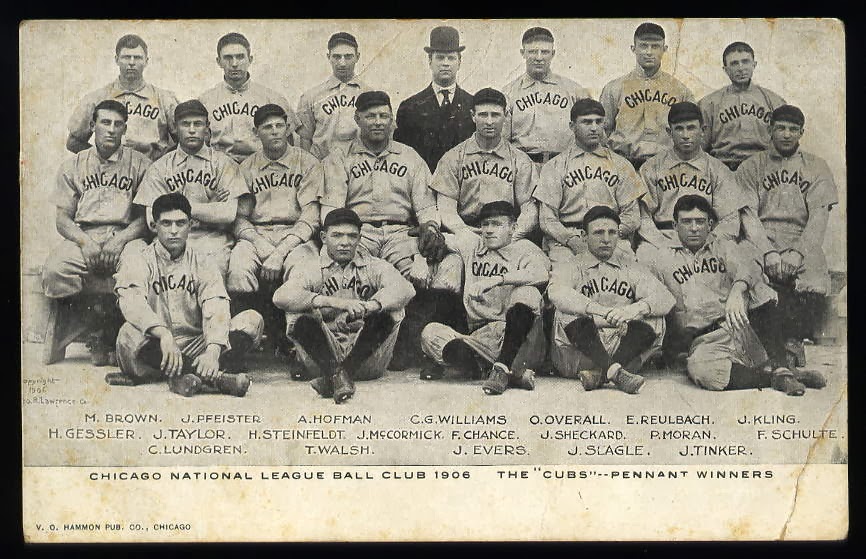
Walsh was a member of the winningest team in MLB history, the 1906 Cubs, but just barely. (He did make it into the team picture, though. That's him, second from left, in the front row.) Tom was a catcher, and got into exactly two games (one in August, and one in September). He was also given only one opportunity to hit. (He struck out.) Despite being only 21 years old, Walsh never played another game in the big leagues. According to Baseball Reference, he never played a game in the minor leagues either.
~Dolan Nichols 1930 (Cubs 1958)
Nick, as he was called by his teammates, was a reliever for the 1958 Cubs. In 24 appearances, he earned one save. The Cubs sent him back down to the minors by mid-season, and although he got another shot in September after the rosters were expanded, that was the exent of his big league career. Nichols pitched in the minors for a few more years before retiring at the age of 30.
~Jim Kremmel 1948 (Cubs 1974)
He was the ninth overall pick of the draft in 1971, but by December of 1973, he was the player to be named later in the Ron Santo trade with the White Sox. Kremmel appeared in 23 games for the Cubs in 1974, his most extended time in the majors. His lifetime ERA was a disappointing 6.08.
The A/V Club
On this day in 1981, the Cubs traded Dave Kingman. He may have been a clubhouse cancer, but he had unbelievable power. This video shows his monumental homer (the third longest homer in Wrigley history) in 1979. Notice he's wearing #10, a number now retired by the Cubs (in honor of Ron Santo)
Thursday, February 27, 2014
JOBC Cubs Almanac--February 27
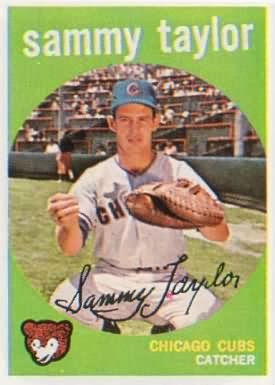
Taylor was a catcher for the Cubs in the late 50s and early 60s. His best season with the bat was 1959, when he clubbed 13 homers. But he also had a very rough time of it behind the plate, leading the league in homers and stolen bases allowed. He was also a key participant in the strangest play in Cubs history, on June 30, 1959 when two balls ended up in play at the same time. It all started when a missed strike three got away from him. Taylor, thinking it was a foul ball, didn't go after the ball. The bat boy, also thinking it was a foul ball, picked it up and tossed it to field announcer Pat Pieper. Pieper saw that the batter was running to first base, so he realized it was a live ball, and let it drop at his feet. Third baseman Alvin Dark ran over to grab it. Meanwhile, the umpire gave Sammy Taylor a new ball out of habit. In the confusion, the runner on first base, Stan Musial, made a run for second base. Cubs pitcher Bob Anderson took the ball out of Sammy Taylor's catcher's mitt and fired it to second base at the same time that third baseman Alvin Dark threw his ball to second base. Ernie Banks was covering second and caught one of the balls heading his way, while the other ball escaped into centerfield. Ernie tagged out Musial with one ball, while center fielder Bobby Thomson lobbed the other ball into the dugout. Thinking that "real" ball has been tossed into the dugout, Musial kept on running and scored. The umpires had a very long discussion about this play on the field before finally ruling that Musial was out because Ernie tagged him. The Cardinals were enraged by the call on the field and lodged an official protest. The protest wasn't necessary. The Cardinals won the game anyway, 4-1. (Photo 1959 Topps Baseball Card)
~Bud Teachout 1904 (Cubs 1930-1931)
Bud had a good rookie season in 1930, winning 11 games with a 4.06 ERA, quite an accomplishment considering 1930 was a season for hitters. Many hitting records were set that year, including Hack Wilson's 191 RBI. Bud's Cubs team, however, choked a big lead down the stretch, and just missed repeating as NL Champs. That collapse cost Hall of Fame manager Joe McCarthy his job. (He went to the Yankees and won seven World Series, including one against the Cubs). Teachout was traded in 1931 along with Hack Wilson in the trade that brought Burleigh Grimes to Chicago.
~Leroy Herrmann 1906 (Cubs 1932-1933)
He pitched in relief for the pennant winning 1932 Cubs, but didn't make it on the postseason roster. Leroy pitched in 16 games over his two Cubs seasons, earning two wins and a save, but struggling mightily with big league hitters. His lifetime ERA is over 6.
~Carl Warwick 1937 (Cubs 1966)
Warwick was an outfielder for six big league seasons. He was the starting centerfielder for the expansion Houston Colt 45s, but was mainly a defensive replacement for the Cubs in 1966, for whom he got his final twenty-two at-bats in the majors. He earlier played for the Orioles, Cardinals and Dodgers.
~Ron Hassey 1953 (Cubs 1984)
Hassey had a long and successful career as a backup catcher (14 seasons in the big leagues). He came to the Cubs along with Rick Sutcliffe in the trade that sent Joe Carter and Mel Hall to the Indians. Hassey didn't get a lot of playing time backing up Jody Davis, but he was a part of the team that won the division. The Cubs traded him to the Yankees after the 1984 season.
~Matt Stairs 1968 (Cubs 2001)
Stairs was brought in to play first base for the Cubs, even though he had previously only played a handful of games at that position. It didn't work out. The Cubs traded for Fred McGriff at the trading deadline to take his place. Nevertheless, Stairs did hit 16 homers in a Cubs uniform, and got several clutch hits during that 2001 season. That was his only year in Chicago, but he did play ten more seasons in the big leagues, and won a ring with the Phillies in 2008.
~Willie Banks 1969 (Cubs 1994-1995)
He was a World Champion with the 1991 Twins and was brought to Chicago by his old general manager Andy McPhail, but Banks didn't pitch well in Chicago. His two seasons with the Cubs were the strike years of 1994 and 1995. Before the strike he was hit hard as a starter. After the strike he was hit hard as a reliever. The Cubs traded him to the Dodgers in June of 1995.
~Craig Monroe 1977 (Cubs 2007)
The Cubs acquired Monroe from the Tigers to help them down the stretch during their division winning season of 2007. He had been a key contributor the Tigers' World Series team the previous year, but he fizzled in Chicago, hitting only .204, and not making the postseason roster. Two bits of trivia about Monroe: his mother is named "Marilyn Monroe" and his cousin is former Bears defensive back Nathan Vasher.
A/V Club
On this day in 1998, Harry Caray was laid to rest. His good buddy Pete Vonachen gave a very memorable tribute...
Wednesday, February 26, 2014
JOBC Cubs Calendar--February 26
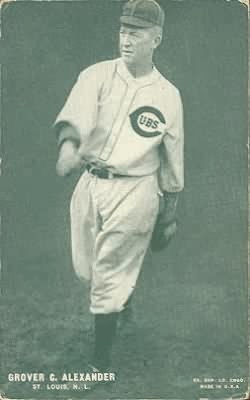
His 373 wins are the third most in baseball history. And yes, he was a Cub. He won 128 games in his years with the Cubs, and had one of the best seasons in baseball history in 1920, when he led the league in wins, ERA and strikeouts. But Alexander was troubled during his Cubs years. The only reason they got him at all was because the owner of the Phillies didn't want to get stuck paying the contract of his star pitcher (a three-time 30 game winner) if he got drafted into World War I. He did get drafted, and he came back from the war a changed man. Old Pete, as he was known, became one of the biggest drinkers in the league--during Prohibition. He showed up drunk to games. He fell asleep in the clubhouse and passed out drunk in the dugout. He smoked like a chimney before every game. He ignored his manager, and openly challenged his authority. The Cubs were understanding up to a point. After all, the man was suffering through medical, physical and mental problems. He was an epileptic, and was prone to seizures. His arm started hurting during his Cubs career, and he had the ligament "snapped back into place" by a man named James "Bonesetter" Smith. And throughout it all he was suffering from post-traumatic stress disorder after his horrific war experience. Somehow, against all odds, he continued to pitch well. In 1923, he pitched 305 innings and walked only 30 men. In 1924, he won his 300th game. But in 1926, after his catcher and best friend Bill Killefer went to the Cardinals, Alexander fell apart. In his last ten games with the Cubs, Old Pete showed up drunk six times, and missed two games altogether. The Cubs released him and the Cardinals picked him up on waivers. Back with his best friend Killefer, he regained his pitching touch and led the Cardinals to the World Series championship, winning Game 6, and saving Game 7 of the 1926 series. Two years after his 1950 death, his story was told in the film "The Winning Team," starring Ronald Reagan. Grover Cleveland Alexander remains the only player in baseball history to be named after a president, and portrayed in a movie by a president.
~Harry Weaver 1892 (Cubs 1917-1919)
Harry pitched for the Cubs during their early years in the new ballpark on Clark & Addison. He won three games in three big league seasons, but pitched fairly well in his limited opportunites. Harry stuck around in the minors until 1924.
~Joe Graves 1906 (Cubs 1926)
Joe played exactly one day in the big leagues, and it was for the Cubs on September 26, 1926, the last day of the season. He played third base in the first game of a double header against Brooklyn and got one at bat against Dazzy Vance (he didn't get on base). He started the second game of the double header and went 0 for 4. The Cubs lost both games.
~Don Lee 1934 (Cubs 1966)
He pitched in 16 games for the Cubs and went 2-1 with a 7.11 ERA. That was a very bad team...in fact, it still has the worst record in Cubs history (103 losses). His stint in Chicago marked the end of his big league career. He finished up with 40 wins in nine big league seasons with the Tigers, Senators, Twins, Angels, Astros and Cubs. His father Thornton also pitched in the Major Leagues (mostly for the White Sox)
~Jose Reyes 1983 (Cubs 2006)
Not to be confused with the stud infielder Jose Reyes (Mets, Marlins, Blue Jays), this Jose Reyes was a catcher who got a cup of coffee with the Cubs at the end of the 2006 season. He batted five times and struck out three of those times. He also got 2 RBI with his only big league hit. He was signed by the Mets the following year but never made it up to their big league club.
~Hector Rondon 1988 (Cubs 2013)
The Venezuelan was a Rule 5 pick for the Cubs, and made their opening day roster in 2013. He pitched in 45 games for a team that people simply stopped watching.
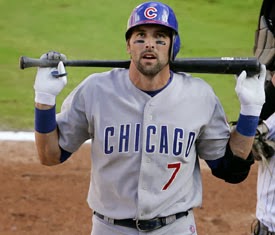
DeRosa played 16 seasons in the bigs, the best two of which were with the Cubs. He was an important part of the first back-to-back playoff teams for the Cubs in a century. DeRosa played wherever the Cubs needed him (OF, 1B, 2B, SS, 3B), and seemed to get all the clutch hits. He can't even be blamed for the collapse in both of those playoff series because he hit over .300 each time, although he did make a key error in Game 2 of the 2008 NLDS. The Cubs traded him after the season for pitcher Chris Archer. Before retiring, DeRosa won a World Series ring as a member of the 2010 San Francisco Giants.
A/V Club
Grover Cleveland Alexander in action during the 1926 World Series...
Tuesday, February 25, 2014
JOBC Cubs Almanac--February 25
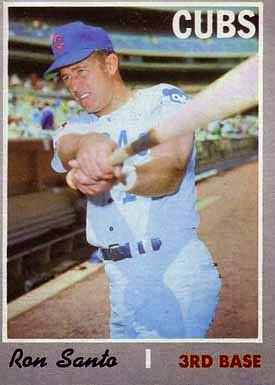
He was the captain of that ill-fated (but incredibly talented) 1969 Cubs team--the man who clicked his heels after each Cubs victory. Santo was also the one who had the black cat cross his path while he stood in the on-deck circle in New York. Ron Santo is a Hall of Famer, something he wanted to be more than anything else in the world. Unfortunately, he wasn't inducted until after his death. His credentials should never have been questioned. Santo was a nine-time All-Star and five-time Gold Glover at third base. He hit 342 homers, and was the dominant player at his position (in the National League) during his playing days. And he did it all despite suffering from diabetes. After his playing career he joined the Cubs radio broadcast booth, teaming up with the great Pat Hughes. He lost both legs to diabetes during his broadcasting days, and made an even stronger bond with Cub fans. He never complained about his medical misfortune, and he exhibited the same kind of raw emotion that Cub fans experience: Incredible joy when they won, and pure agony when they lost. His number was retired in 2003 and a flag commemorating Santo now flies on the left field foul pole at Wrigley Field.
~Howard J. Earl 1869 (Colts 1890)
They called him "Slim Jim" because he was a tall and lanky infielder. He played first, second, and third base for the second place team. Hall of Famer Cap Anson was his manager during his only year in Chicago.
~Zeppo Marx 1901 (Cubs fan 1909-1920)
The Marx family had moved from New York to Chicago in 1909. For much of that time they lived in a large house at 4512 South Grand Boulevard (now called Martin Luther King Boulevard). The house is still there. The Marx Brothers (Gummo, Groucho, Harpo, Chico, and Zeppo) were already a traveling Vaudeville Act in April of 1917 when America entered World War I. They had been touring in the south when War was declared. But the war forced them to take drastic measures: they purchased a farm in LaGrange, Illinois. Their mother had heard that farmers were going to be exempt from military service, and she wanted to do whatever was necessary to keep her boys out the fight...even if it meant becoming farmers. This is the way Groucho Marx described his days on the LaGrange farm..."The first day we got up at 5 in the morning. The second morning we dawdled until 6. By the end of the first week we slept until noon, which gave us just enough time to catch the 1:07 train to Chicago to see the Chicago Cubs play." They became regulars at Wrigley Field (then known as Cubs park) during the World Series year of 1918. The Marx family moved back to New York in the fall of 1920 and a decade later they moved west to Hollywood.
~Monte Irvin 1919 (Cubs 1956)
Irvin was nicknamed "Mr. Murder" for the way he murdered the baseball. He was a star in the Negro Leagues and didn't make his debut in the Majors until 1949 at the age of 30. But even though he only played a few big league seasons and hit only 99 career homers, he was inducted into the Hall of Fame in 1973. He had a few great seasons with the Giants, leading them to the National Leauge pennant in 1951, and the World Series championship in 1954. When the Cubs got him in 1956, he was already 37 years old. His power stroke was diminished, but he was still the best leftfielder in the league. In his last big league season he led the National League in fielding percentage and range.
~Bob Brenly 1954 (Cubs announcer 2005-2012)
He was a former big league ballplayer (Giants, Blue Jays) and World Series winning manager (Diamondbacks) before joining the Cubs television booth. Brenly and Len Kasper formed a great team during their years together. Brenly was known for his tough criticism of certain players (especially Alfonso Soriano), and he and Kasper often also riffed about rock and roll (and even played together on stage at the House of Blues every year before the Cubs convention). He left the Cubs booth after the 2012 season when the Arizona Diamondbacks offered him a chance to broadcast the games of the team he took to the championship.
~Ed Lynch 1956 (Cubs 1986-87, Cubs GM 1994-2000)
Lynch was a journeyman starter for the Mets in his seventh big league season when the Cubs acquired him in June of 1986. The Mets would go on to the win the World Series without Ed, while the Cubs finished in 5th place. After a year and a half with the Cubs, Lynch retired. He worked in management with the Padres for a while before being named the General Manager of the Cubs in 1994 by team president Andy McPhail. He made some good trades (acquiring Henry Rodriguez) and some bad trades (trading Jon Garland for Matt Karchner), but he was mainly let go because the Cubs only reached the post season one time during Lynch's years at the helm. He's currently working as a scout for the Toronto Blue Jays.
~Henry Rodriguez 1987 (Cubs 2013)
Not to be confused with the Henry Rodriguez who played left field for the Cubs in the late 90s, this Henry Rodriguez (no relation) is a pitcher with a dynamite fastball. Unfortunately, he can't control it. In his five big league seasons (through 2013), he has 36 wild pitches in only 148 innings pitched. He signed with the Miami Marlins in 2014.

Nicknamed "Handy Andy," because of his incredibly dependable hitting and fielding, Pafko was one of the most popular Cubs, and a star of their last World Series team of 1945. "Handy Andy" was a five-time all-star during his Cubs career, the first three times as an outfielder (although one of those times, 1945, they didn't play the all-star game because of the war). After legendary Cubs' third baseman Stan Hack retired after the 1947 season, Pafko replaced him on the hot corner long enough to be named an All-Star there too, making him one of the few people to achieve All-Star status in both the infield and outfield. His 1950 season can only be described as "DiMaggio-esque". That year Andy Pafko knocked the ball out of National League ballparks 36 times while only striking out 32 times. Only 14 players have ever accomplished that feat. Pafko’s 1950 season was so impressive that Reds’ president Warren Giles said if he could choose any player in the National League to help improve his team, he would choose Pafko. Naturally, Handy Andy was rewarded for that incredible season in true Cubs fashion. He was traded to the Brooklyn Dodgers. He was crushed when the Cubs traded him, and it was a trade that Chicago would forever regret. The players they got in return had almost no impact with the Cubs, while Pafko would go on to play in the 1952 World Series with the Dodgers and the 1957 and 1958 World Series with the Braves. He came back to his hometown of Chicago after his playing career was over, settling in the northwestern suburbs, and passed away in 2013 at the age of 92.
A/V Club
Today's Cubs birthday boy Ron Santo went through serious medical problems, even during his playing career...
Monday, February 24, 2014
JOBC Cubs Almanac--February 24

Pinky was a back up third baseman and shortstop for a Cubs team that made history--they were the first Cubs team to ever finish in last place. After that blip year of 1925, the Cubs didn't finish in last place again for another 23 years. Pinky's real name was Clark Alonzo Pittenger, and he was one of the most educated players on the team…he had gone to dental school at Ohio State University. Of course, that didn't stop him from getting involved in an altercation along with his manager (the instigator) Rabbit Maranville, after which both of them wound up in jail. Pinky only played with the Cubs for one season (1925), and he hit .312 in limited action, but the Cubs released him after that season. He played parts of 7 seasons in the majors (3 with the Red Sox, 3 with the Reds, and 1 with the Cubs) and in more than 1000 Major League plate appearances he managed to hit exactly one home run.
~Wilbur Cooper 1892 (Cubs 1925-1926)
Cooper is one of the most successful left-handed pitchers in baseball history. He was a four-time 20-game winner, and won over 200 games in his big league career. The Cubs got him along with Charlie Grimm and Rabbit Maranville after the 1924 season. He had just won 20 games for the Pirates, and was not happy to be traded to the Cubs. He felt the Pirates were on the verge of winning it all, and he was right. The trade robbed him of his only chance to pitch in the World Series. (The Pirates won it all in 1925). His time in Chicago was disappointing. He went 12-14 for the last place 1925 Cubs, and was released in June of the following year. At that time he had the career record for most innings pitched and games started as a left-handed pitcher; records that have since been broken.
~Lynn Nelson 1905 (Cubs 1930-1934)
He was a pitcher that was known for his hitting--they called him "Line Drive" Nelson. Nelson had his best season as a pitcher with the Cubs in 1933, when he went 5-5 with a 3.21 ERA. His best season as a hitter came in 1937 (with the A's), when "Line Drive" hit four home runs. Unfortunately he was also prone to giving up the long ball. In 1939 he led the league with 27 homers allowed.
~Earl Grace 1907 (Cubs 1929-1931)
Earl was a catcher who got a cup of coffee with the Cubs in two different seasons--1929 and 1931. He was traded to the Pirates early in 1931 for fellow backup catcher Rollie Hemsley. Earl's best season was 1932 when he hit eight homers for the Pirates. Grace remained in the big leagues until 1937.
~Mike Sember 1953 (Cubs 1977-1978)
Sember was a local boy (Hammond, Indiana) who got a cup of coffee with the Cubs in the late 70s. He was mainly a defensive replacement at shortstop and third base. Sember had a grand total of seven career big league at bats (all with the Cubs), and got two hits (both singles).
~Rob Bowen 1981 (Cubs 2007)
The Cubs got him from the Padres in the Michael Barrett trade in June of 2007, and Bowen was expected to become their regular catcher. After going 2 for 31, the Cubs traded him to the A's a month later for Jason Kendall.
A/V Club
The 1925 World Series champion Pirates featured ex-Cub George Grantham, and future Cub Kiki Cuyler...
Subscribe to:
Posts (Atom)